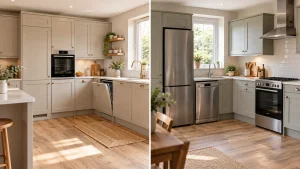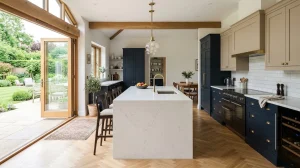
When planning a kitchen renovation, few decisions carry as much weight as selecting your cabinetry. Kitchen cabinets aren’t just practical storage units—they form the visual backbone of the entire room, dictating its flow, texture, and overall personality.
According to UK industry benchmarks, cabinetry typically accounts for 30% to 40% of an overall kitchen budget—representing a typical investment of £3,000 to £12,000+ on supply alone, depending on specification. Beyond immediate costs, property data from Nationwide shows that a well-executed kitchen transformation can boost overall home valuation by 4% to 6%, making cabinetry an investment where design aesthetics and practical durability must meet seamlessly.
       ┌────────────────────────────────────────────────────────┐
       │             KITCHEN BUDGET BREAKDOWN (TYPICAL)         │
       └───────────────────────────┬────────────────────────────┘
                                   │
         ┌─────────────────────────┼─────────────────────────┐
         ▼                         ▼                         ▼
  ┌─────────────┐           ┌─────────────┐           ┌─────────────┐
  │ Cabinetry & │           │ Worktops &  │           │ Appliances, │
  │ Units       │           │ Fitting     │           │ Trades & Plumb│
  │ (35% - 40%) │           │ (25% - 30%) │           │ (30% - 35%) │
  └─────────────┘           └─────────────┘           └─────────────┘
With dozens of door styles, engineered timber grades, storage mechanisms, and finishes available, choosing the right combination can quickly feel overwhelming. This decision guide breaks down the essential factors to ensure you choose cabinetry that elevates your home, fits your daily routines, and stands the test of time.
Step 1: Define Your Kitchen Style & Aesthetic
Before looking at material swatches or hardware finishes, take a step back and consider the overarching architectural character of your home. Industry survey data reveals that cabinetry accounts for over 67% of total kitchen furniture market revenue, meaning the cabinet doors you select will single-handedly define the mood of your kitchen.
       ┌────────────────────────────────────────────────────────┐
       │                CHOOSE YOUR CABINET STYLE               │
       └───────────────────────────┬────────────────────────────┘
                                   │
         ┌─────────────────────────┼─────────────────────────┐
         ▼                         ▼                         ▼
  ┌─────────────┐           ┌─────────────┐           ┌─────────────┐
  │ Contemporary│           │   Shaker    │           │ Traditional │
  │ & Handleless│           │    Style    │           │   & Inset   │
  └──────┬──────┘           └──────┬──────┘           └──────┬──────┘
         │                         │                         │
  Sleek, minimal,           Versatile, clean,         Detailed trim,
  push-to-open doors        timeless aesthetic        classic moldings
1. Contemporary & Handleless
For contemporary homes and urban layouts, modern cabinetry prioritizes uninterrupted sightlines and minimalist flat-panel (slab) profiles. Handleless designs—utilizing continuous recessed J-pull channels or electronic push-to-open mechanisms—create an uncluttered feel that makes smaller spaces appear significantly brighter and larger.
2. Shaker Style
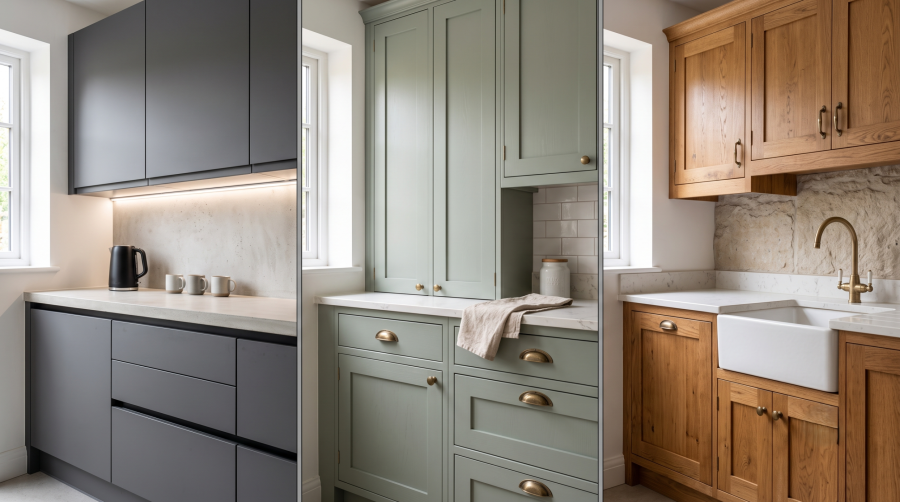
The Shaker door remains the UK’s most specified door style across both traditional homes and modern extensions. Defined by a simple four-piece frame surrounding a recessed center panel, its unpretentious framing pairs effortlessly with almost any aesthetic. Paired with aged brass cup handles, it leans classic; paired with matte black slim bars, it leans contemporary.
3. Traditional & Inset
If your home leans toward Victorian, Georgian, or period country aesthetics, traditional cabinetry features detailed decorative molding, raised center panels, and visible joinery. Inset cabinetry—where the door sits flush inside a solid timber frame rather than mounting over it—offers an elegant, hand-built look reminiscent of heritage British craft.
Design Tip: Align your cabinet door style with your home’s structural age. A sleek handleless kitchen looks striking in a modern townhome or extension, whereas period properties naturally suit the architectural framing of Shaker or in-frame cabinetry.
Step 2: Select the Right Material & Finish
The materials beneath the surface dictate how well your kitchen withstands daily steam, ambient humidity changes, and constant foot traffic. Understanding material cores ensures you balance longevity with your renovation budget.
Solid Wood vs. High-Density MDF
- Solid Hardwood (Oak, Ash, Walnut): Unmatched in natural warmth, tactile weight, and structural strength. Solid timber accounts for over 56% of UK wood cabinetry installations—ideal for stained finishes where you want natural grain variations visible. However, solid timber naturally expands and contracts with atmospheric humidity changes.
- High-Density Fiberboard (MDF / HDF): High-grade MDF is engineered specifically to remain dimensionally stable, meaning it won’t warp, split, or expand near cooking steam or sinks. Because it lacks natural grain, high-density MDF provides an ultra-smooth substrate for spray-painted finishes, making it the gold standard for smooth painted Shaker and slab doors.
Exploring Finishes
- Factory-Sprayed Painted Finishes: Applied in multi-coat dust-free booth environments for a seamless, washable finish. Deep blues, forest greens, and warm charcoal tones add grounding character, while soft sage greens and off-whites remain top choices for light distribution.
- Stained Wood: Preserves and accentuates the grain pattern of real wood, introducing organic texture to island units or accent cabinetry.
- High-Pressure Laminates & Polymer Foils: Highly resilient against impact, scratches, and moisture. Modern polymer finishes mimic real timber and tactile stone at a lower entry cost, offering fast lead times and easy maintenance for busy households.
Step 3: Choose Between Stock, Semi-Custom, and Fully Bespoke
How your cabinets are manufactured affects not only the baseline price tag but also how effectively they maximize every millimeter of floor area.
| Cabinet Category | Customization & Sizing | Typical Lead Time | Average Supply Cost (10–12 Units) | Best Suited For |
| Stock / Flat-Pack | Fixed standard increments (15cm steps) | Immediate – 1 week | £1,500 – £4,000 | Quick refreshes & standard square rooms |
| Semi-Custom / Rigid | Factory-assembled, variable depths & finishes | 3 – 6 weeks | £4,000 – £9,000 | Standard homes needing tailored layouts |
| Fully Bespoke | Tailored to exact room dimensions, angles & heights | 6 – 10 weeks | £10,000 – £25,000+ | Period properties, awkward alcoves & max storage |
                 TRADITIONAL STOCK vs. BESPOKE SPACE USAGE

    [ Stock Cabinets: Standard Sizing ]      [ Bespoke: Full Height & Width ]
    ┌───┐ ┌───┐ ┌───┐ ░░░░░░░░░░░░░░░        ┌──────┐┌──────┐┌──────┐───────┐
    │   │ │   │ │   │ ░ Dead Space  ░        │      ││      ││      │       │
    │   │ │   │ │   │ ░ & Gap Fillers        │      ││      ││      │ No    │
    └───┘ └───┘ └───┘ ░░░░░░░░░░░░░░░        └──────┘└──────┘└──────┘ Gaps  │
Opting for bespoke or custom cabinetry eliminates awkward filler panels, blank corner boxes, and unutilized top gaps. If your property features irregular chimney breasts, sloping ceilings, or low beams, bespoke cabinet sizing turns layout quirks into usable storage space.
Step 4: Prioritize Functionality & Smart Internal Storage
A kitchen can look stunning on the outside, but without intuitive internal storage, daily meal prep becomes chaotic. Modern kitchen design heavily prioritizes ergonomic pull-out hardware that brings items directly to you.
                  ┌────────────────────────────────────────┐
                  │      ESSENTIAL STORAGE ORGANIZERS      │
                  └───────────────────┬────────────────────┘
                                      │
         ┌────────────────────────────┼────────────────────────────┐
         ▼                            ▼                            ▼
┌──────────────────┐        ┌──────────────────┐        ┌──────────────────┐
│  Deep Pan Drawers│        │  Corner Systems  │        │ Tall Pull-Outs   │
├──────────────────┤        ├──────────────────┤        ├──────────────────┤
│ Replaces standard│        │ LeMans carousels │        │ Full-height larder│
│ lower cupboards  │        │ retrieve items   │        │ storage for      │
│ for heavy cookware│       │ from deep corners│        │ dry goods        │
└──────────────────┘        └──────────────────┘        └──────────────────┘
Essential Storage Features Worth the Investment:
- Deep Pan Drawers: Replacing standard low cupboards with deep, full-extension drawers increases accessible storage volume by up to 30%, eliminating the need to bend down and reach into dark back shelves.
- Full-Height Pull-Out Larders: Single tall larder units hold up to 100kg of dry goods across multi-tier wire or solid-base baskets, giving you instant visual access to ingredients from both sides.
- Corner Carousels (LeMans Units): Traditional blind corner cupboards often waste up to 50% of their volume. Articulated LeMans tray systems glide completely out of the cabinet frame, bringing heavy items out into the room.
- Concealed Waste & Recycling Separation: Integrated dual or quad-bin pull-outs keep food waste and dry recyclables hidden out of sight while eliminating freestanding bin clutter.
- Heavy-Duty Soft-Close Hardware: Premium drawer runners and soft-close hinges (rated for 40kg–70kg dynamic weight limits and tested up to 200,000 opening cycles) protect cabinet doors from wear and ensure whisper-quiet operation.
Step 5: Budgeting & Visualizing Before You Buy
Because new kitchen cabinetry represents a long-term commitment, proper planning before trades begin prevents expensive mid-project revisions.
Realistic Budgeting Framework
When setting your total budget, allocate realistic reserves for trade labor and materials:
- Cabinetry Units & Fittings: 35% – 40%
- Worktops (Quartz, Granite, Solid Wood): 15% – 20%
- Appliances (Oven, Hob, Integrated Refrigeration): 15% – 20%
- Installation Trades (Fitting, Electrical, Plumbing, Plastering): 20% – 25%
- Contingency Fund: Always set aside 10% to 15% for unexpected structural, plumbing, or electrical remediation uncovered during old unit removal.
The Power of 3D Design Software
Never commit to a cabinetry layout based solely on two-dimensional floor plans. Modern design studios utilize advanced CAD and 3D rendering tools, enabling you to inspect clearance distances, experiment with light reflection, test color contrast against worktops, and evaluate spatial workflow before a single door is manufactured.
Evaluating Warranties
Quality joinery should always be backed by substantial long-term guarantees. Look for manufacturers offering 10-year guarantees on kitchen cabinetry and lifetime guarantees on internal drawer runners and hinges. A long warranty indicates high confidence in carcass density and hardware performance.
Final Decision Checklist
Choosing the perfect kitchen cabinets comes down to balancing personal taste with structural quality and clever internal organization:
- [ ] Aesthetic: Have you picked a door style (Contemporary, Shaker, or Inset) that complements your property’s architecture?
- [ ] Material Core: Did you choose stable, moisture-resistant MDF for painted doors or solid timber for stained finishes?
- [ ] Layout Efficiency: Does the layout maximize vertical space and eliminate dead corners using pull-out larders and pan drawers?
- [ ] 3D Review: Have you reviewed a full 3D visual render to confirm light levels, colors, and walkway clearance?
- [ ] Warranty Check: Do your units come backed by a minimum 10-year warranty?